I’m lazy. Quite lazy. But I have a kind of compulsive laziness. That means I will work very, very hard to be able to be lazy. Lately that has meant trying to build software with Claude Code without checking the code. And, to my surprise, I’m getting close to a working process. I’m not hands off: the process takes a fair bit of my input to keep the machine running. But I’m not coding, and I’m leaving the code reviews to the machine.
I’m not the only one trying this. Uncle Bob Martin says much the same: “I don’t review code written by agents. I measure things like test coverage, dependency structure, cyclomatic complexity, module sizes, mutation testing” (Martin, 2026a). Though even he still reads one thing: “My agents write the unit tests. I don’t review those. They also write the gherkin acceptance tests… I review those” (Martin, 2026b). So do I, as you’ll see.
That only works if the machine can be trusted, and by default AI cannot be trusted to do a good job. So this post is about what I have to do to trust the machine. As I have said before AI development — Same problems but faster: AI doesn’t create new kinds of failure, it makes the old ones happen faster. So in a fixed time span you see more of those problems. But the answer isn’t a new method, it’s the old discipline, applied more strictly than a human team ever needed. And by strict, I mean enforced by machinery rather than by memory.
I’m hoping this is the first post in a series on my AI development experiences. This post has the overview and the later ones will dive into various aspects. Stay tuned.
Three kinds of session
I like having somebody to talk to about different kinds of problem, so I split my Claude Code work into three categories, each with a different session type:
- A shaping session works with me. It discusses, decides, writes the documents and files the work as tickets. It writes no code, and a deny list stops it if it tries.
- A delivery session builds. It takes one ticket, writes a failing test, makes it pass, and merges its own pull request once CI is green. The proverbial code monkey.
- A strategy session looks after the whole portfolio, and writes the rules the other sessions work by. A delivery session can’t edit those rules, so it can’t change them to get itself unstuck.
Each session spawns sub-agents when the work calls for them, but only the shaping and strategy sessions talk to me.
A small example from one afternoon. A delivery session spotted two places holding the same data and suggested refactoring the duplication away. Before changing anything it measured, and found that although a lot was copied, enough to warrant a refactor, there were differences too. The shaping session brought me two ways forward. Reading the product’s own definitions, I could see the code wasn’t the problem: the technical design was. So we fixed the design first, and then I let the delivery session loose. We shipped a refactor, just not either of the two solutions I’d been offered.
One human gate, then autonomy to Live
I can code, but I don’t. Nor do I review the code. Despite that, I find I’m very, very busy.
What I focus on is shaping — what might be called discovery by others or analysis and design if you are old school. That is my ‘gate’. Which behaviours get built, in what order, to what technical design. Each behaviour is written as an executable specification, a Gherkin scenario, and the ‘3 Amigos’ of BDD lives on: before any of it is built, the shaping session reviews on behalf of development, two fresh sub-agents review for testing, and finally I review for the business. I don’t write one big spec up front. Each increment gets its discovery when it’s next in line.
After that, AI runs autonomously to Live. Claude Code builds the slice, CI proves it green, Claude Code reviews and fixes its own work, and Claude Code merges it. Nobody approves the pull request. I don’t review the merge.
Lazy? Yes. But I worked very hard to earn the right to be lazy.
Why keep a human gate at all? Making AI behave is harder than you’d think. And that means we shouldn’t let it make the big decisions. A page said to come from a 1979 IBM training manual put it plainly: “A computer can never be held accountable. Therefore a computer must never make a management decision” (Willison, 2025). Which work gets built, and what done means, are management decisions, so they’re mine. Everything after them is execution.
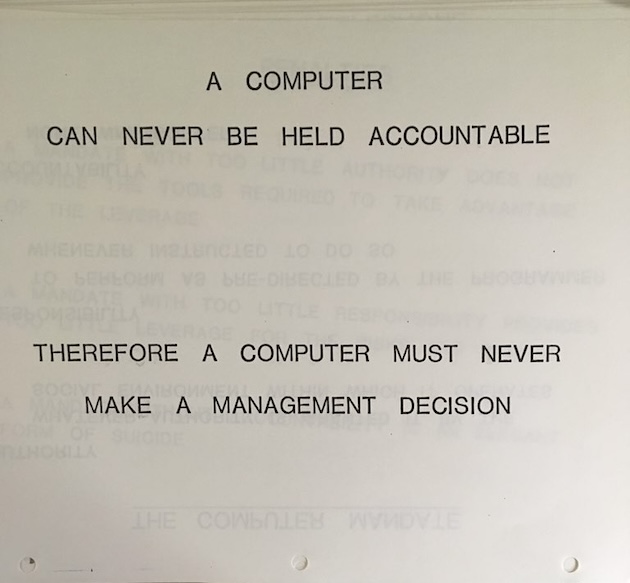
Photo: @bumblebike, 2017, via Willison (2025).
This isn’t trust handed over on faith. Trust is a bank of evidence, built slowly, and every new collaborator starts at zero, human or AI. My trust rating for Claude Code has been slowly rising but only because I have a lot, I mean a lot, of controls in place.
Mechanism over honour
For a long time I relied on documented process to keep Claude in line. Kind of an honour system. “Hey Claude, remember that we agreed you wouldn’t …”. This approach reflects what I do for myself. Write down the process. An acknowledgement that my memory is rubbish.
But it turns out Claude Code’s memory is even worse than mine. Documented standards don’t really work with Claude. It talks a good game (“Yes, that is exactly what I’ll do”) but cannot live up to it. At the start of a session Claude might obey a process document but by the end of a session it doesn’t (“Sorry, I should have read the document but I relied on my memory”). And if Claude never reads the process document at all, then the process is out the window. The wild west of AI land.
So I try to minimise what Claude needs to remember. Instead I mechanise. When I catch a process fault, the catch becomes a gate so it doesn’t repeat. Then we start again. Continuous improvement.
The mechanisms sit at every step: hooks that refuse a session’s dangerous commands before they run, checks on every commit, a suite of quality gates on every build, and a nightly mutation run that stops the line if it goes red, so nothing new starts until the fix is live. Here is just one example: an AI session told another to push straight to main but a hook refused the command before anything ran. Simple. No memory needed.
Wherever possible, the gates are other people’s tools. Claude Code is very happy to build new tools all the time, but I prefer to reuse what is already proven in the wild. One day my delivery sessions merged seven home-made scripts, each a legitimate quality check. Two of my own rules seemed to conflict, and Claude settled it by building. That was a total fail because I want to reuse existing tools rather than build. So my quality checks now include ESLint for complexity and function length, dependency-cruiser for keeping the code in the shape of its design, and others.
Correctness is two records that agree
I’m a big fan of automated testing, because Brakes Let You Go Faster. But a test suite on its own is one record, and one record can be wrong or faked. An AI that makes a failing test pass by deleting it leaves you a quiet green. So each behaviour is recorded twice, independently: what the specification claims, and what the tests observe. My reconciliation step matches the two, the way double-entry bookkeeping matches debits to credits. Out of balance turns the build red. To get a wrong change through, you’d have to corrupt both records consistently, and that can only be deliberate, never an accident.
I first wrote about this in What Software Development Can Learn from Double-Entry Bookkeeping, back in April 2025. It’s even more useful now that the AI writes the code.
One limit is worth stating. Reconciliation proves the change was deliberate, not that it was right.
Some delivery numbers
I’m a numbers kind of guy, and a big fan of data-driven delivery, so I thought I’d share some numbers from the 3F factory floor. Be warned, there is a massive use-with-caution sign alongside this data: one product, small well-specified scenarios, 3F process, one person supervising.
- Throughput. In the four weeks to 2026-11-19, two delivery sessions finished 973 work items, about 17 a day each. The human baseline I’ve worked to is one work item per engineer per day, so Claude is doing alright.
- CI is fast, and getting faster. Over the same four weeks, the median CI run fell week by week: 2.6 minutes, then 2.5, 2.4 and finally 1.2. In the final week, none of 331 runs took over five minutes, and inside each run the unit tests took a median of 5 seconds and the integration tests 6.
- AI review still finds things after every gate has passed. In a trial in mid-October,
/code-reviewraised 37 findings on four already-merged pull requests. Only two were worth a fix, but neither had been caught by anything else.
This is not click-your-fingers AI productivity. Sure, I once built an iPhone app in 15 minutes while talking to my mate on the phone. But that app was AI slop and unmaintainable. What I’m trying to build at 3F are apps with all the “-ilities”, apps that could run in a corporate. In that context, the productivity I’ve got from Claude is pretty good.
On the down side, my rework stats look dire: a quarter of those 973 work items (240) were rework, meaning refactoring, faults and tech debt. I think that reflects me refining the process more than problems with the application. I’m in a continuous improvement cycle, and I cycle a lot. I spot a problem in the app, work out how it came about and how to prevent it, and the prevention becomes a change to the 3F method. Along the way I’ve found 41 rework patterns, and I now check for the foreseeable ones at design time. So far the check isn’t lowering the rework, though fewer of the patterns turn up each time, and I’ll take that as a small win.
References
Martin, R. C. [@unclebobmartin]. (2026a, April 14). I don’t review code written by agents… [Post]. X. https://x.com/unclebobmartin/status/2044114698451476492
Martin, R. C. [@unclebobmartin]. (2026b, July 23). My agents write the unit tests… [Post]. X. https://x.com/unclebobmartin/status/2080278104849744349
Willison, S. (2025, February 3). A computer can never be held accountable. Simon Willison’s Weblog. https://simonwillison.net/2025/Feb/3/a-computer-can-never-be-held-accountable/